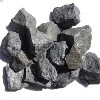
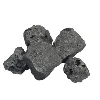
The factors affecting the quality of ferrosilicon balls mainly include raw materials, production processes, equipment operation, storage environment, and other related aspects.
1. Raw Material Quality
- The silicon and iron content, as well as the proportion of impurities in ferrosilicon, directly determine the quality of the briquettes.
- The silicon content influences the reduction performance and metallurgical effect of the briquettes. Different applications require specific silicon content levels.
- Excessive impurities such as phosphorus and sulfur can degrade the performance of steel products and must be strictly controlled.
- The ratio of ferrosilicon to binder also affects the strength and shaping quality of the briquettes. An unreasonable mix may result in weak bonding and poor structural integrity.
2. Production Process Parameters
- The particle size distribution of crushed ferrosilicon significantly affects the density and strength of the briquettes.
- Overly coarse particles may lead to poor internal bonding and easy breakage, while overly fine particles can increase energy consumption and reduce permeability after forming.
- The fineness of the milled powder must match the requirements of the forming equipment, and the particle size should typically fall within a specified range.
- The pressing force of the briquetting machine directly affects the density and strength of the briquettes. Insufficient pressure results in loose and easily cracked briquettes, while excessive pressure may cause excessive wear on the equipment or even "overpressure" breakage.
- Moisture content during mixing is a key factor in shaping. Insufficient water prevents the binder from working effectively.
- During the drying process, dehydration must occur evenly. Large moisture differences between the inside and outside of the briquettes may cause cracking.
3. Equipment and Operational Standards
- The mold design of the briquetting machine influences the briquette's appearance, such as roundness and surface smoothness.
- Mold wear or dimensional deviations may lead to inconsistent size and strength of the briquettes.
- The stability of conveying belts and screening equipment affects transportation and sorting efficiency. Excessive vibration or impact may cause briquette breakage.
4. Storage and Transportation Environment
- Ferrosilicon balls are highly hygroscopic. Long-term exposure to humid environments can lead to moisture absorption, powdering, and reduced strength and compositional stability.
- During transportation, vibrations and jolts may cause the briquettes to collide and break, especially over long distances or on poor road conditions.
- In open-air transport, rainwater may erode the briquettes, causing surface powdering or component loss. Proper moisture-proof measures are essential.
Our company is a professional ferroalloy manufacturer with a wide range of products and good quality. Welcome to contact us!
wangwei@dedaoferrosilicon.com