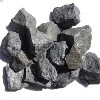
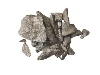
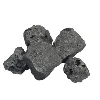
Ferro boron lump is a common auxiliary inoculant for cast iron metallurgy. Cast Iron Inoculant Ferro Boron Lump is conditionally applicable to the production of malleable iron pipe fittings (black heart malleable cast iron). When used with correct dosage and matching processes, it optimizes casting structure, shortens annealing cycles, and stabilizes mechanical and galvanizing performance.
Working Mechanism in Malleable Iron Production
Malleable iron fittings require defect-free white iron blanks and complete graphitization annealing. Ferro boron improves production in two key ways:
1. Refines as-cast structure: Boron combines with molten iron nitrogen to form fine BN nucleation particles, refining cementite distribution, reducing shrinkage porosity and thread defects, and eliminating local gray spots caused by uneven wall thickness.
2. Accelerates graphitization annealing: Trace boron effectively promotes cementite decomposition, uniformizes flocculent temper carbon distribution, shortens the annealing cycle by 10%–18%, and lowers production energy consumption.
It also improves ferrite matrix uniformity, enhancing fitting toughness and ensuring a dense, uniform zinc layer after hot-dip galvanizing.
Application Limitations (Not Recommended Scenarios)
- Ultra-thin wall fittings (<3 mm): Boron increases white iron tendency, easily causing incomplete annealing and brittleness.
- High-precision threaded/ wear-resistant fittings: Excess boride precipitates reduce machinability.
- Unstable molten iron nitrogen: Causes fluctuating BN nucleation effect and inconsistent batch quality.
Field Application Effect
In mass production of galvanized malleable iron pipe fittings, the compound inoculation scheme (silicon-barium inoculant + trace ferro boron) stably reduces product rejection rate, shortens heat treatment time, and makes tensile strength, elongation and galvanizing quality fully meet GB/T 3287 industry standards.
By strictly controlling residual boron content and combining this with composite inoculation technology, casting quality can be optimized and production costs reduced. For special ultra-thin-walled and high-precision malleable iron pipe fittings, the use of iron-boron blocks should be minimized or eliminated.