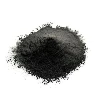
Black silicon carbide is the most widely used type on the market, offering high cost-effectiveness and suitability for large-scale industrial applications.
Key Features:
- High hardness and excellent wear resistance
- Relatively economical cost
- Suitable for processing ordinary steel
Common Applications:
- Abrasive materials
- sandblasting for rust removal
- refractory materials
- foundry industry
For routine grinding or wear-resistant applications, black silicon carbide is typically the preferred choice.

Green silicon carbide boasts higher purity and slightly greater hardness than black silicon carbide, making it suitable for more demanding machining scenarios.
Key Features:
- High purity
- Sharp particles
- Strong cutting capability
Common Applications:
- Tungsten carbide machining
- precision grinding
- optical glass processing
If you require superior material cutting performance or premium abrasive products, green silicon carbide is the more suitable choice.

Classified by Application
Abrasive-Grade Silicon Carbide
Used in grinding wheels, sandpaper, and polishing materials.
Requires strict particle size distribution, commonly adhering to F-series or P-series standards.
Refractory-Grade Silicon Carbide
Primarily used in high-temperature kilns, castables, and refractory bricks.
Emphasis on high-temperature resistance and oxidation resistance.
Metallurgical-Grade Silicon Carbide
Commonly used in steelmaking and casting as a deoxidizer or carbon additive.
Greater focus on composition stability and reaction efficiency.
How to Select the Right Silicon Carbide?
If this is your first purchase, consider the following guidelines:
For general abrasives → Black silicon carbide
For high-end grinding → Green silicon carbide
For refractory materials → Refractory-grade silicon carbide
For steelmaking additives → Metallurgical-grade silicon carbide
Of course, the final decision will depend on your specific application scenario, ingredient requirements, and particle size standards. If you're unsure which model to choose, please provide your usage scenario or technical specifications, and we can offer a more reasonable recommendation based on our experience.