


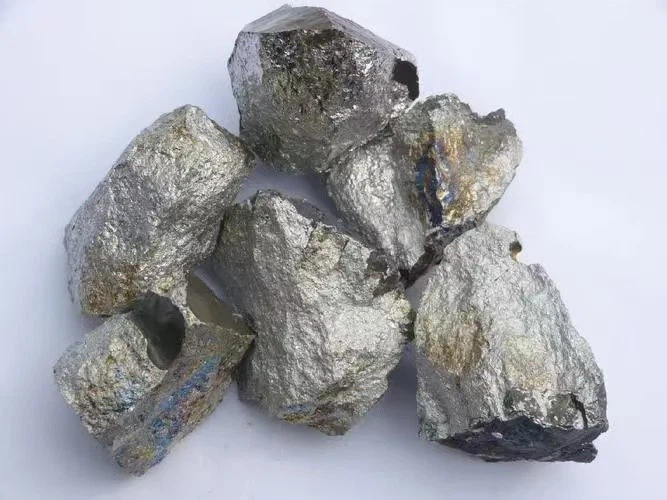
ferromanganese
It is one of the main alloying agents used in steel industry.
Introduction to metal ores
Trace of ferromanganese

National standard range
This standard specifies the product classification, technical requirements, acceptance rules, inspection rules, packaging, storage and transportation, marking and quality certificate of ferromanganese. This standard is applicable to ferromanganese used as deoxidizer and alloying element additive for steelmaking and casting.
smelting process
Blast furnace smelting, electric furnace smelting
Technical situation
We have won a lot of awards for strong creativity
Modern large-scale ferromanganese reduction furnace capacity of 40,000 ~ 75,000 kVA, generally fixed closed. The smelting power consumption of the flux method is generally 2500 ~ 3500 kW · h/ton, and the power consumption of the non-flux method is 2000 ~ 3000 kW · h/ton.
Electric furnace refining
Medium and low carbon ferromanganese are generally desilicated and refined by 1500 ~ 6000 kVA electric furnace, with manganese silicon, manganese rich ore and lime as raw materials.
The reaction is: MnSi+2MnO+2CaO -- →3Mn+2CaO·SiO2
The use of high basicity slag can reduce the manganese content of slag and reduce the manganese loss caused by slag abandonment. In the joint production, the slag with low basicity (CaO/SiO2 less than 1.3) is operated, and the slag with high manganese content (20 ~ 30%) is used for smelting manganese silicon alloy. The preheating of the charge or the loading of liquid manganese silicon alloy can shorten the smelting time and reduce the power consumption. Refining power consumption is generally about 1000 kW · h. Medium and low carbon ferromanganese are also produced by thermal blending of liquid manganese-silicon alloy with manganese ore and lime melt.
gas-blowing refining
Medium and low carbon ferromanganese can be produced by blowing liquid carbon ferromanganese or manganese silicon alloy with pure oxygen. After years of experimental research, this method entered industrial scale production in 1976. From "Global Ferroalloy Network Global Ferroalloy network Global Ferroalloy network Global Ferroalloy network"
electric furnace smelting

Reduction smelting of ferromanganese has two kinds of flux method (also known as low manganese slag method) and no flux method (high manganese slag method). The principle of the flux method is the same as that of blast furnace smelting, except that electric energy replaces the coke used for heating. By adding lime to form high basicity slag (CaO/SiO2 1.3 ~ 1.6) to reduce the loss of manganese. A low iron and low phosphorus manganese rich slag with low alkalinity (CaO/SiO2 less than 1.0) and high manganese content is formed by fluxless smelting without lime. In this method, the amount of slag is small, the power consumption can be reduced, and the evaporation loss of manganese can be reduced because of the low slag temperature. At the same time, the by-product manganese rich slag (containing 25 ~ 40% manganese) can be used as the raw material for smelting manganese silicon alloy, and the comprehensive recovery rate of manganese is higher (more than 90%). Modern industrial production mostly adopts flux-free smelting of carbon ferromanganese, and forms a joint production process with manganese silicon alloy and smelting of medium and low carbon ferromanganese.
Previous
ManganeisenYou Might Also Like


Send Inquiry